
Pre-Calculus Project Section
Functions in the Fight Against Breast Cancer
THE QUESTIONS:
Q1: During Pink October a mobile health clinic visits schools and malls in Bahrain. It can give 40 check-ups per day. The number of check-ups after d days is S(d) = 40d, for 0 ≤ d ≤ 20.
(a) Find S(5) and S(20). Write the domain and range of S.
S(5) = 40(5)
S(5) = 200
S(20) = 40(20)
S(20) = 800
Graph:
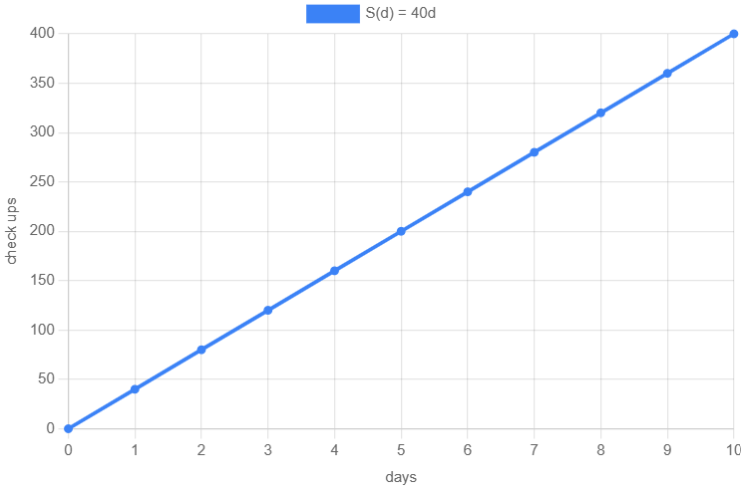
Domain: [0, 20]; Range: [0, 800]
(b) Find the inverse S⁻¹(x). How many days are needed for 600 check-ups?
S⁻¹(x) = x/40
= 600/40
= 15 days.
(c) Each check-up takes 15 minutes, so the time is T(S) = S/4 hours. Find T(S(d)) and explain what it means.
T(S)d)) = 40d/4
= 10d
The clinic works 10 hours a day.
______________________________________
Q2: GLOBOCAN 2024 gives the new breast cancer cases and the number of women in each country: Bahrain 433 (610,024 women) · Qatar 440 (875,493) · Kuwait 982 (1,918,882) · UAE 1,774 (3,980,643). Rate per 100,000 women = cases ÷ women × 100,000.
(a) Calculate the rate per 100,000 women for each country (one decimal place). Which country has the highest rate?
Bahrain: 433 ÷ 610,024 × 100,000 = 70.98… ≈ 71.0 (highest rate)
Qatar: 440 ÷ 875,493 × 100,000 = 50.25… ≈ 50.3
Kuwait: 982 ÷ 1,918,882 × 100,000 = 51.17… ≈ 51.2
UAE: 440 ÷ 1774 ÷ 3,980,643 × 100,000 = 44.56… ≈ 44.6
(b) Why do we compare rates and not only the number of cases?
We compare rates since in this case, the mentioned countries have different populations. Using rates makes the comparison reasonable. Obviously, the UAE would have the highest NUMBER of cases. But since rates are more important, Bahrain has the highest RATE.
(c) Suppose Bahrain’s cases grow by about 15 each year: B(t) = 433 + 15t, t years after 2024. Find B(4) and solve B(t) = 500.
B(4) = 433 + 15(4)
B(4) = 493
Graph:
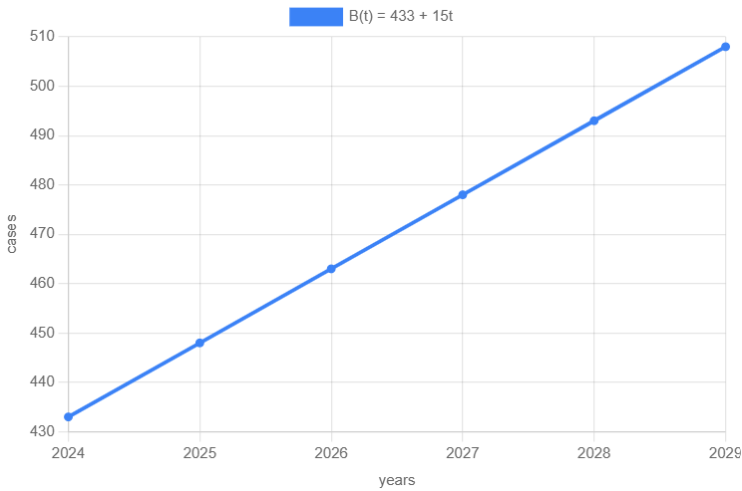
Since B(t) = 433 + 15t:
433 + 15t = 500
15t = 67
t ≈ 4.5
Graphs 1A and 2C have one thing in common: they are both linear functions; the two functions increase at a constant rate.
The graphs above were made using our graphing tool, which is right below.
Line Graphing
Introduction:
Breast cancer is one of the biggest medical challenges in the world, but fighting it takes more than just medicine—it also takes Math. While we usually look at topics like functions as just equations on a chalkboard, researchers and doctors use them every day to save lives. By turning unpredictable cell growth into predictable Math models, doctors can figure out exactly what a tumor is doing and how to stop it.
How Calculus Supports Early Detection & Support for Breast Cancer:
1) Calculating Tumor Growth Using Equations & Models:
By using mathematical equations and models, a better understanding can be acquired when a tumor grows into a certain size. For example,the exponential growth model can be used to determine when the tumor grows into a certain size within some days.
2) Optimizing Screening Protocols and Technology:
By tracking how fast different types of cancer grow and looking at the limits of screening tools like mammograms and blood tests, Calculus helps figure out the right schedule for checkups. This is helpful for tricky cases, like screening younger patients or women with dense breasts, so doctors can avoid giving patients false alarms.
3) Customizing Treatment Plans:
By measuring the tumor's size and calculating the exact medication dose needed to shrink it, the right amount of treatment can be delivered without using too little or too much. This way, patients get just enough treatment to destroy the cancer safely without giving them too little to work or too much that it harms healthy tissue.
How Calculus Supports Early Detection and Treatment for Breast Cancer:
Calculus helps doctors catch and treat diseases early by turning body data, like scans and DNA, into computer models. This lets researchers spot tiny warning signs before a person feels sick, making it much easier to treat illnesses successfully and build custom plans for each patient.
How Calculus Helps with Breast Cancer Treatment:
Can Calculus help physicians make better decisions for cancer patients? A new study led by Professor Tom Yankeelov, Director of the Center for Computational Oncology at the Oden Institute for Computational Engineering and Sciences, suggests the answer is, “yes.” The team developed a biology-based Calculus model capable of predicting how breast cancer responds to neoadjuvant chemotherapy, which is given before surgery to shrink tumors. By using magnetic resonance imaging (MRI) scans acquired at the beginning of treatment and just three weeks later, the model accurately forecasted tumor changes after nine weeks. Mathematical Medicine Group at the University of Waterloo have been applying mathematical and computational approaches to understand cancer growth and control for more than a decade now. Working together with cancer biologists and clinical oncologists, they are trying to understand some of the challenges in cancer treatment, including drug resistance and relapse. Calculus models allow for quick searching and identification for the most effective drug combinations for cancer patients. They are also deepening our understanding of how and why cancer cells often become resistant to chemotherapy drugs. They believe that this growing interaction of scientists with cancer biologists and clinical oncologists will also lead to many future advances and breakthroughs in cancer treatment.
Conclusion:
In conclusion, this project highlights how mathematical concepts are directly applied to solve critical real-world problems in medicine. Before conducting this research, it was difficult to see how abstract topics like exponents and logarithms connected to biochemistry. However, looking at the data shows that mathematics is essential for helping doctors understand, track, and treat breast cancer effectively.
Sources:
- S. Meenakshi. (2025). EMPOWERING EARLY BREAST CANCER DETECTION: HARNESSING THE RELIEF ALGORITHM AND DIVERSE AI MODELS FOR IMPROVED DIAGNOSTICS. International Journal of Applied Mathematics, 38(7s), 180–193. https://doi.org/10.12732/ijam.v38i7s.473(Credibility: Authors behind the article are verified in Google Scholar)
- Saad, F. T., Gambo, Y. Y., Wongsantisuk, P., Ahmed, I., & Tariboon, J. (2025). Mathematical modeling of the effect of early detection in breast cancer treatment. Frontiers in Oncology, 15. https://www.frontiersin.org/journals/oncology/articles/10.3389/fonc.2025.1626435/full(Credibility: Authors are verified in ResearchGate)
- Baker, R. D. (1998). Use of a mathematical model to evaluate breast cancer screening policy. Health Care Management Science, 1(2), 103–113.https://link.springer.com/article/10.1023/A:1019046619402(Credibility: Author is verified in ResearchGate)
- ecancer.https://ecancer.org/en/news/13975-mathematical-methods-for-diagnosing-breast-cancer(Credibility: They have verified themselves in the UK, with the proof of this info: UK registered charity number: 1176307)
- Rockne, R. C., Hawkins-Daarud, A., Swanson, K. R., Sluka, J. P., Glazier, J. A., Macklin, P., Hormuth, D. A., Jarrett, A. M., Lima, E. A. B. F., Tinsley Oden, J., Biros, G., Yankeelov, T. E., Curtius, K., Al Bakir, I., Wodarz, D., Komarova, N., Aparicio, L., Bordyuh, M., Rabadan, R., … Scott, J. G. (2019). The 2019 mathematical oncology roadmap. In Physical biology (Vol. 16, Issue 4, p. 041005). PubMed Central. https://pmc.ncbi.nlm.nih.gov/articles/PMC6655440/ (Credibility: Authors behind the article are verified at Google Scholar)
- How mathematics is helping to fight cancer. (2018, March 7). Applied Mathematics.https://uwaterloo.ca/applied-mathematics/news/how-mathematics-helping-fight-cancer (Credibility: A verified university from Canada)
- Cancer, B. (2025). Predicting Breast Cancer Treatment Responses with Mathematical Models. Oden Institute for Computational Engineering and Sciences.https://oden.utexas.edu/news-and-events/news/Predicting-Breast-Cancer-Treatment-Responses-with-Mathematical-Models/(Credibility: It is from the University of Texas, which is from the USA which has been authentic)